Frequently Asked Questions about Drinking Water
Massachusetts Water Resources Authority
Because drinking water is a natural resource, its taste, color and odor can sometimes vary slightly from day to day, from town to town and from faucet to faucet. MWRA's drinking water is treated according to strict state and federal standards so that it is safe to drink. Here are some answers to some frequently asked questions about drinking water.
MWRA provides drinking water to 53 communities. Some communities are only partially-supplied by MWRA and some are in our Chicopee Valley Aqueduct system. More detailed information about the where the water in your city or town comes from and how it is treated available in our Annual Water Quality Report.
Lead
Could there be lead in my tap water?
MWRA water is lead-free when it leaves the reservoirs. MWRA and local water mains do not add lead to the water. However, lead can get into water through a lead service line (the pipe that connects your home to the main in the street) or household plumbing. For more information, visit our What You Need to Know About Lead In Tap Water page.
Top
Fluoride
Is there fluoride in my tap water?
The Massachusetts Water Resources Authority is lowering the amount of fluoride added to the water it supplies in accordance with a new recommendation from the Centers for Disease Control (CDC). For more information visit our Fluoride in Drinking Water page.
Top
Discolored Water
Yellowish Water:
In winter, we sometimes get yellowish-looking water from our taps. It stains our bathroom and kitchen fixtures and also our laundry. Why is this happening? Is it safe to use? How can we remove the stains?
MWRA water, which comes from the Quabbin and Wachusett Reservoirs, sometimes turns yellowish from low levels of dissolved iron picked up from old iron pipes in both our system and your community's water system. This mainly occurs in winter, when water usage is low, because the water sits in the pipes for a longer period of time. The water may not be aesthetically pleasing, but according to the federal Environmental Protection Agency (EPA), increased levels of iron that produce yellow water are not public health threats. Hardware stores have inexpensive products to remove rust stains from clothing and household surfaces. MWRA and customer communities replace or rehabilitate old pipes a few miles at a time, an expensive and time-consuming process. Long term solutions take time, but we are constantly cleaning and replacing as much pipe as we can.
Top
Rusty, Red or Orange Water:
From time to time I get rusty-looking water at home. Sometimes I can even see little specks of rust floating in the water. What is the cause of this, and what should I do when it happens?
Red water, named after the red or black rust specks you asked about, sometimes occurs when there is an increase or change in water flow, largely caused by water main breaks, fire hydrant activations, and flow direction changes made by local towns. These occurrences knock off small particles of rust and stir up sediments in the pipes. It is a temporary condition that usually clears up in a couple of hours. Your local water department should know what is happening at that particular time, and how long the condition should last. If possible, you should refrain from using water -- for laundry, dishes, cooking and drinking -- until the condition clears up.
Top
Cloudy or White Water:
The hot and cold water from our kitchen sink sometimes comes out very cloudy. If we leave the water in the container, it then clears up quickly and the cloudiness disappears. Should we be using this water, even after it turns clear?
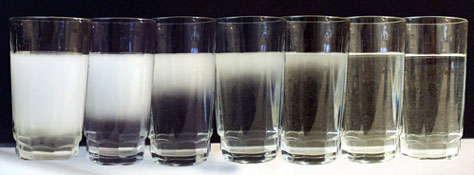
Cloudy water, also known as white water, is caused by air bubbles in the water. It usually happens when it is very cold outside and air gets mixed in with the water supply. It is completely harmless. The best thing to do is let it sit in an open container until the bubbles naturally disappear.
Top
Home Water Filters
Clogging Filters:
I have installed a filter for my water, and it is getting clogged at a quicker rate than is expected – is this is a problem?
Many filters will have lower flow as they near the end of their lifespan, indicating that they need to be replaced. MWRA’s drinking water is unfiltered, so filters may not last as long as they would in a filtered water system. This is due to the natural organic matter that is in the water supply. This organic matter is not a health concern. Also, in the late winter and early spring, there are natural increases in algae levels that can clog filters. Some years are higher than others, depending on weather conditions. Also, if you have older iron pipes, corrosion particulates may cause your filter to clog prematurely.
Home Water Filters:
Do I need to filter my drinking water?
MWRA delivers high quality water that meets or exceeds all state and federal drinking water regulations. Filtration is typically not required, however, you may have a taste preference, health condition, or a water quality issue caused by your home plumbing that filtration can address.
What issues can a home water filter address?
- Lead removal. While lead is not found in MWRA source waters, lead can be found in the plumbing inside some homes and businesses. Lead in household plumbing can dissolve into drinking water when it sits in the pipes for several hours. A lead-certified filter will remove lead.
- Taste and odor preference. Some customers prefer the taste and smell of filtered water, or they may have old iron pipes in their home that impact the taste of their water.
- Chlorine sensitivity. Customers with a chloramine sensitivity may prefer to filter their drinking water or install a showerhead that removes chloramine.
How do water filters work?
Many filtration systems use carbon, charcoal, or a blend of filter media to remove contaminants when water flows through the filter media. Depending on the type of filter, contaminants either get trapped in the pores of the filter or they adhere/absorb to the surface of the filter media. For Reverse Osmosis (RO) systems, the water is usually treated with a pre-filter, a carbon filter, an RO membrane, and a post-filter.
What should I know before purchasing a home water filter or treatment device?
Determine what you want a treatment device to do, such as remove tastes and odors, or remove contaminants, such as lead. To learn more about MWRA’s water quality, view our Annual Water Quality Report.
When selecting a filter, it is important to know that not all filters are the same. Read the packaging carefully and only purchase certified filters. Visit www.nsf.org for more information.
- NSF/ANSI Standard 42: Filters with this certification change the aesthetics of the water and reduce non-health related contaminants. The contaminants reduced will vary by filter.
- NSF/ANSI Standard 53: Filters with this certification reduce contaminants that are harmful to health. The contaminants reduced will vary by filter.
- NSF/ANSI Standard 58: This certification applies to Reverse Osmosis treatment systems.
- NSF/ANSI Standard 177: This certification applies to showerhead filtration systems, for the reduction of free chlorine.
Do not rely on the NSF/ANSI certification alone. Make sure the packaging specifically lists the contaminant you wish to reduce. For example, you may find two filters that are both NSF/ANSI 53 certified, but only one of them may have been certified for lead reduction.
What types of certified filters are on the market?
A variety of filters exist to meet your needs. These include pour-through pitchers/carafes, faucet mount filters, counter top or under sink filters, showerhead filters, and refrigerator filters.
What is the difference between a point-of-use filter and a point-of-entry filter?
Point-of-use (POU) filters treat water only where/when you need it, such as at your kitchen sink or refrigerator. POU filters are often more economical, but if you wish to treat water at multiple locations in the home, you will need to buy a filter for each location. POU filters are a good choice when you want to remove contaminants that originate in your home plumbing, such as lead.
Point-of-entry (POE) filters treat all water that enters the home, including toilet water, bath water, laundry water, and in some cases water at outside spigots. POE filters may be more expensive, and will not address issues in the plumbing that are located after the filter, such as lead solder. If you have a POE filter that removes chlorine and sodium hydroxide, you are removing the disinfectant and pH adjustment in the water. This could lead to bacterial growth and corrosion of home plumbing.
Do showerhead filters remove chloramine?
The NSF/ANSI Standard 177 is for showerheads that claim to reduce free chlorine. Since MWRA uses chloramine (chlorine + ammonia) and not free chlorine, filters with the NSF/ANSI 177 standard may not work effectively. Some certified showerheads on the market with granular activated carbon claim to also reduce chloramine. Customers may have success with vitamin C showerhead filters, but these are not certified.
Do filters require maintenance?
If filters are not replaced according to the manufacturer’s guidelines, you run the risk of it no longer performing as designed. For example, a filter designed to remove 99% percent of lead can only do so for a specific volume of water. Unmaintained filters can also harbor bacteria. Many filters have a device that indicates when to change the filter.
Are there alternatives to filtration?
If you have lead in your plumbing, you should try to have it removed. You should also check with your local water department about lead service lines. More information is available on our What You Should Know About Lead in Tap Water page.
Flushing your faucet will also address taste and odor issues if you have older iron pipes. To remove chlorine taste and odor, add slices of lemon to a pitcher of water, as the ascorbic acid (vitamin C) will help dechlorinate the water. Boiling water can also reduce chlorine levels, however you should not boil water to remove lead.
Top
Hardness, Softness, pH, Sodium
Hardness/Softness:
Is MWRA Drinking Water Hard or Soft?
MWRA's drinking water is soft. If you are an MWRA customer, you probably don't need to use special water softeners for your clothes - or dishwashing machines. You do not need a water softener. Water's "hardness" and "softness" is due to its concentration of minerals –calcium and magnesium. The lower the mineral concentration, the softer the water is. MWRA's drinking water has a hardness of approximately 16 milligrams per liter, or 1 grain per gallon. When using water that is considered soft you do not need to use as much dishwashing soap, laundry detergent, or other soaps. Many new dishwashers allow you to set the hardness of the water so that you do not need to use as much soap in comparison to areas that have hard water.
Top
pH:
What is the pH of MWRA drinking water?
MWRA treats its drinking water so that it has a pH of approximately 9.0-9.5, a slightly alkaline measurement. This pH level helps to reduce the potential that water will leach metal that might be in your household plumbing. Untreated, "raw" water in MWRA's Quabbin Reservoir has a pH of approximately 6.8, close to neutral. pH measures the amount of hydrogen ion activity in a substance. The pH scale is relative and runs from 0 to 14. 0 is the lowest, and most acidic, pH level. 7 is neutral. 14 is the highest, and most alkaline, pH level.
Top
Sodium:
Is there sodium in MWRA drinking water?
MWRA tests for sodium regularly and the highest level found was 33.4 milligrams per liter (about 7 milligrams per glass). This is considered to be a very low level of sodium by the FDA. Sodium in water contributes only a small fraction of a person's overall sodium intake.
Top
Tastes and Odors
Chlorine taste or smell:
In summer my water smells like chlorine. Why does this happen, and how can reduce the odor?
MWRA disinfects its water to protect against harmful bacteria (from birds, animals, and even humans) that can enter into reservoirs. MWRA uses ozone and ultaviolet light (UV) to kill any harmful bacteria at the CWTP in Marlborough. Ozone and UV leave no taste or odor, and in fact improves the natural taste of the water. To protect the water as it travels through the miles of pipe to get to your house, MWRA uses a mild disinfectant called mono-chloramine that has very little taste or odor. Occasionally those with sensitive palettes may find their water has the odor of chlorine. It usually doesn't last long, and is related to the normal adjustment of the mono-chloramine treatment. This is more likely in the summer when water is warmer. Chilling the water usually eliminates it. You can leave a pitcher of water in the refrigerator. If you use a pitcher or water bottle, don’t forget to wash it.
Top
Fishy or earthy taste or smell:
In spring and fall, we sometimes notice a fishy or earthy taste and odor to our water. What causes this, and is it safe to drink?
This is probably the result of algae growth in one of the water system's reservoirs, partially caused by the change of season. Different types of algae can cause your water to smell fishy, moldy, grassy or even like cucumbers or violets. Refrigerating the water can help eliminate the odor, and adding a slice of lemon will remove any bitter taste.
In the meantime, when a funny taste or smell is first detected in the water supply, MWRA moves quickly to correct the problem with a limited application of copper sulfate to control the natural algal growth in the affected reservoir. That eventually solves the problem.
Top
Bacteria
What does MWRA do about bacteria in drinking water?
Bacteria are everywhere we go in the world, but there are certain types of bacteria we don't want to see in our water supply, because of public health concerns. Communities regularly take water samples, which are then analyzed in laboratories for bacteria counts. A particular type of bacteria that they test for -- coliform -- serves to indicate that harmful germs may also be present. If total coliform are detected in more than 5% of samples in a month (or if more than one sample is positive when less than 40 samples are collected), the water system is required to investigate the possible source/cause with a Level 1 or 2 Assessment, and fix any identified problems. In addition, when coliform are found in samples, the lab conducts additional testing to determine if a specific type, E. coli, is present. If E.coli is present, this is considered evidence of a critical public health concern. Usually the solution in this case is to boil the water until the problem is solved. MWRA, the Mass. Department of Conservation and Recreation (DCR), and others work hard to assure protection of area reservoirs, especially against birds, dogs, other animals and even swimmers getting into water supplies. MWRA’ state of the art treatment with ozone, UV, and chloramine combine to ensure our water is free from contamination.
Top
Stained Plumbing Fixtures
Green Stains:
We're getting green stains on our bathtub. Someone told us it's a result of copper piping. Why does this happen?
Green stains on plumbing fixtures are indeed a result of copper leaching from the plumbing in your house. This is a not usually a problem for MWRA communities, although the problem may occur from time to time. MWRA does adjust the pH of the water to reduce the tendency of copper and lead to leach into your drinking water.
Top
Pink Stains:
From time to time, I get pink stains in my bathroom, laundry room, or kitchen sink. What is the cause of these stains and how can I get rid of them?
These pink stains are usually caused by biofilms, and are not harmful. The pink growth is not from the water, but from bacteria or other microorganisms in the air that thrive in damp areas. It is mostly observed in the area between water and air, in locations that stay moist. Biofilms can also be found in shades of yellow or brown, orange, or red. Because they thrive in the presence of water and small amounts of nutrients, biofilms are found virtually everywhere there is water, including sinks, toilets, shower curtains, humidifiers, ice makers, and water purification systems. Scrubbing and chlorine bleach are the best solutions to eliminate the occurrence of the pink residue. An easy way to do this is to stir three to five tablespoons of bleach to the toilet tank, flush the toilet to allow the bowl to be disinfected, and add another dose of bleach to the tank as it is refilling. By keeping bathtubs and sinks wiped down and dry, the formation of pink residue can be avoided.
Top
Manganese
I have heard about manganese and water. Is it a concern? What do you find in the water?
Manganese is a common naturally-occurring mineral found in rocks, soil, groundwater, and surface water. Most water has small amounts of manganese in it. The US Environmental Protection Agency (EPA) and Massachusetts Department of Environmental Protection (MA DEP) have set an aesthetics-based secondary standard for manganese in drinking water of 50 parts per billion (ppb). This is not a health standard. At levels greater than 50 ppb, the water may appear brown, taste unpleasant and may leave black stains on bathroom fixtures and laundry. MA DEP has recently introduced a health advisory for manganese of 300 ppb. Manganese is an essential nutrient, but DEP’s health advisory suggests that infants not be fed formula made with water containing levels higher than 300 ppb of manganese. MWRA finds very low levels of manganese in the water, usually around 5-10 ppb, which is 5 to 10 times lower than the aesthetic standard and 30 to 60 times lower than the DEP advisory level. MWRA has never exceeded either the secondary standard of 50 ppb or the health advisory of 300 ppb. For more information on water quality and to see current manganese levels, please go to our monthly water quality report. Visit the DEP web site for more information on DEP’s advisory on manganese (PDF).
Top
Back to top
PDF files on this page require Adobe Acrobat Reader® (free download).
Updated
August 23, 2022
|
